
As CPA firms these days are facing a shortage of rising talent, margin pressure, and overwhelming client demands, offshore accounting has emerged as a strategic operating model. It is not just a cost-saving technique anymore. For CPA decision makers, the question is no longer whether offshore accounting should be considered, but how it can help a firm turn into a scalable and advisory-driven one.
This blog is all about an informational and practical overview of offshore accounting. It highlights all the advantages, limitations, and the best use cases for modern CPA firms. You can also learn about how offshore accounting is integrated with CAAS, white-label bookkeeping, and CPA firm scaling strategies.
What is offshore accounting?
Offshore accounting means outsourcing accounting and bookkeeping services from highly trained professionals who are based in global centers. These teams operate as a seamless extension to the CPA firm. They help in handling all the operational execution while firm partners and managers have full control over client relationship management, final review, and scalability.
Common offshore accounting hubs are located in:
- India
- The Philippines
- Eastern Europe
- Latin America
Nowadays, there is a huge demand for offshore accounting. It is commonly embedded within:
- CAAS delivery models
- White-label bookkeeping offerings
- Hybrid onshore-offshore operating structures
This approach allows the CPA firms to expand their capacity, enhance efficiency, and scale services without compromising on quality. Moreover, the CPA has control over every decision.
Why is offshore accounting getting popular with CPA firms?
CPA firms are under pressure from different directions:
- Insistent shortage of staffing
- Rising compensation costs
- Augmented compliance intricacy
- Client demand for advisory insights
Offshore accounting helps different firms in rebalancing resources. This allows the partners and the in-house team to work on the high-value work. In the meantime, the operational tasks that are outsourced are handled in an efficient way.
The pros of offshore accounting
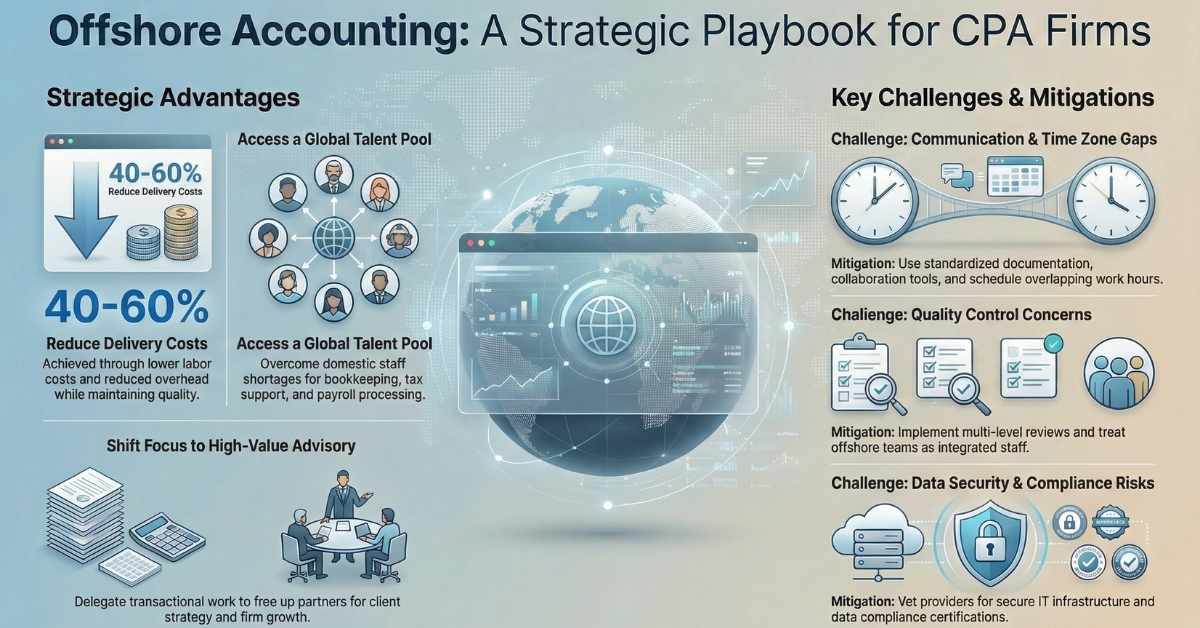
Cost effectiveness, maintaining quality: One of the most cited advantages of offshore accounting is cost control. Offshore teams can reduce delivery costs by 40-60% associated with fully onshore teams.
Cost savings come from:
- Lower labor costs
- Abridged recruitment expenses
- Less overhead for office space and advantages
Moreover, the trustworthy offshore service providers maintain robust hiring, training, and quality assurance standards.
Access to a Larger Talent Pool
When the domestic accounting talent becomes difficult to find, offshore accounting opens access to a global workforce with knowledge in:
- Bookkeeping and general ledger accounting
- Tax preparation support
- Payroll processing
- Financial reporting
This is appreciated by the CPA firms that struggle to hire entry or mid-level staff.
Enhanced scalability and flexibility: Offshore accounting enables CPA firms to scale without any linear increase in headcount. Firms can easily ramp up capacity during the tax season. It can easily scale down when there is no rush or add different services without hiring an in-house team. With this flexibility, it is critical for firms offering subscription-based CAAS and bookkeeping services.
Faster Turnaround Times: When the time zones are different, the offshore teams can work while US-based teams are offline, which enables:
- Overnight processing
- Faster monthly closes
- Quicker reconciliations
When managed properly, this can significantly augment client responsiveness.
Better focus on advisory and client relationships: By delegating transactional work to an offshore team, the CPA firms can easily focus on advisory conversations, strategy, business development, and firm leadership. This shift means supporting the scalability of the business. With the right kind of support accessible, you can look forward to advisory-led growth.
Cons of offshore accounting and how to mitigate them
Offshore accounting offers a wide range of benefits. But it comes along with its own challenges. Understanding these risks is critical for making informed decisions.
- Communication and time zone challenges: Differences in time zones, language nuances, and communication style can create misunderstandings. To mitigate, it is best to use standardized documentation. You can schedule overlapping work hours and also use different collaboration tools.
- Concerns related to quality: Without proper oversight, quality issues can arise, especially when it comes to onboarding. Best practices comprise a multi-level review process, clear escalation protocols, exception-based reviews, and ongoing performance monitoring. High-performing firms treat offshore teams as integrated staff, not any anonymous vendor.
- Data Security and Compliance Risks: CPA firms can handle sensitive financial and personal data, making security non-negotiable. While evaluating offshore accounting providers, ensure they provide proper compliance, encrypted data transmission, safe IT infrastructure, and so on. When its about data governance, be more vigilant.
- Initial setup and transition effort: Offshore accounting is not plug-and-play. Firms need to invest time to do different tasks, including managing document workflows. Training offshore teams and aligning client expectations. However, the investment pays dividends in long-term efficiency and scalability.
Best use cases for offshore accounting
Offshore accounting offers the best value when done with intent and structure. Below are some of the best use cases for CPA firms that are looking forward to enhance efficiency, scalability, and margins without sacrificing quality.
Bookkeeping and transaction processing: It is one of the most established and reliable applications of offshore accounting. The commonly outsourced bookkeeping functions comprise:
- Clarification of different transactions
- Bank reconciliation
- A/R and A/P processing
- Monthly close and schedule preparation
Such activities are highly repeatable, process-driven, and well-suited for consistent workflows from the offshore account.
CAAS delivery support: Offshore accounting can seamlessly integrate into CAAS delivery models as they can easily handle execution-heavy components like:
- Management and internal reporting
- Preparation of financial statement
- Data security
- Budget vs actual analysis
This structure allows onshore teams to remain focused on clarification, advisory conversations, and planned guidance from the client.
White-label bookkeeping services: For CPA firms offering white-label bookkeeping, offshore teams can offer the operational spine needed to scale cost-effectively. Key advantages comprise:
- Flexible capacity to support firm development
- Expected turnaround times
- Budget-friendly expansion of service offerings
From the client’s outlook, service delivery can turn seamless and fully branded under the firm.
Tax preparation and compliance support
Offshore accounting teams can reduce seasonal work pressures by supporting tax compliance activities like:
- Tax return preparation under CPA supervision
- Workpaper assembly and association
- Data reconciliation and validation
This model preserves compliance control while the internal staff works on the core functionality.
Internal firm operations and reporting
Beyond client-facing work, offshore accounting can support internal firms’ operations, comprising:
- Firm-level bookkeeping and accounting
- Internal financial reporting and analysis
- Practice management data preparation
This enhances internal financial visibility, supports leadership decision-making, and also reduces administrative burden.
Important factors for offshore accounting
Successful offshore accounting is driven by discipline, structure, and leadership alignment. CPA decision-makers who get consistent results focus on the following fundamentals:
- Define all the service scopes and role ownership
- In-depth SOPs and well-documented roadmaps
- Organized onboarding and enduring training programs
- Probable communication rhythms and growth paths
- Define measurable KPIs and SLAs
- Tactic cultural amalgamation and team alignment
Companies that treat offshore teams as integrated extensions of their practice are those that realize sustainable, effective, quality, and scalable growth.
Final Thoughts
Offshore accounting is a strategic tool that is great to have. For CPA decision makers, the real value is all about how everything has been implemented and how it has been supported. By understanding all the pros and cons, the CPA firms can make informed decisions that strengthen operations today. Moreover, this helps in the long-term success of an increasingly competitive accounting landscape.
If you want to be effective, scalable, and want advisory growth, then offshore accounting is the key. If you are ready to evaluate offshore accounting for your firm, then it’s time to schedule a free strategy consultation to explore how offshore accounting can help you scale.