
ASC 842 for Property Companies: What Lessor Accounting Demands of Your Lease Data
ASC 842 lessor accounting asks for something most property companies never set out to build: lease data that’s actually complete. Most writing on ASC 842 is written for the tenant side of the transaction. That’s where the standard made its loudest change. Operating leases moved onto the balance sheet, and lessees had to rebuild their reporting around that.
A property company sits on the other side of that same lease. The story there is different. The accounting model didn’t flip. What got harder is proving the data underneath it actually holds up.
Lessor vs Lessee: Why Most ASC 842 Content Isn’t Written for You
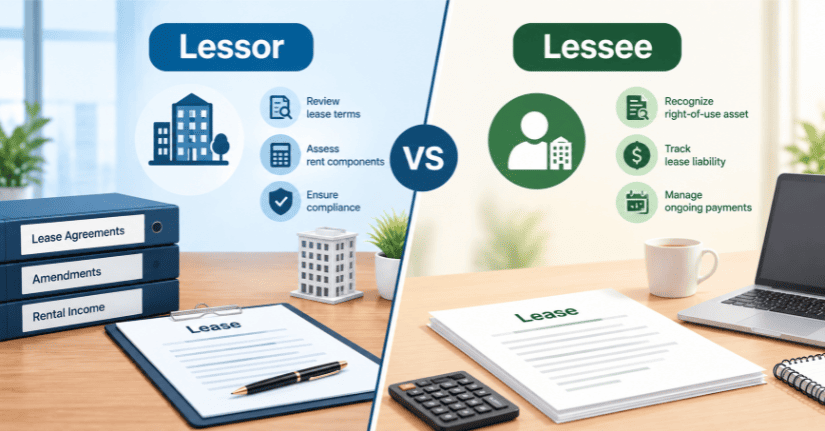
Look up ASC 842, and you’ll find page after page of content written from the tenant’s chair. That’s no coincidence. The headline change in the standard was on the lessee side. So that is where the technical libraries and the software demos put their weight.
The world of a lessor is different. The classification model is still mostly the same. What has changed is the burden of proof. Is the renewal option reasonably certain to be exercised by the tenant? How much rent is fixed and how much is floating? Should service charges be broken out, rather than being bundled into rent? Those answers are in the lease document and every amendment after that. They don’t live in a billing system. They never have.
If you’ve read a handful of 842 explainers and none of them described what you actually do every month, that’s why. Those were written for the person paying the rent. This one is written for the person collecting it.
What Changed for Lessors, and What Didn’t
For a lessor, ASC 842 still classifies leases as operating, sales-type or direct financing. The changes sit around that classification, and each one leans on the lease data.
Collectibility is assessed lease by lease
If collecting a tenant’s remaining lease payments stops being probable, income on that lease is limited to the cash actually received, and the straight-line rent receivable built up so far is reversed against lease income, not charged to bad-debt expense. That needs a documented conclusion for each tenant, and a payment history that can support it.
Initial direct costs got narrower
Only costs that wouldn’t have been incurred without the lease, such as a leasing commission, can be deferred. Salaried leasing staff and legal fees for negotiating the lease are expensed as they’re incurred. Telling the two apart depends on how leasing costs were coded when they were paid.
Lease and non-lease components have to be identified
Say a tenant pays one all-inclusive monthly amount for base rent plus a share of the building’s landscaping and security. The rent is the lease component. The landscaping and security are services, a non-lease component. Property tax and insurance reimbursements are neither: they aren’t a service to the tenant, so they’re part of the total payment that gets split between the two.
The standard’s starting point is to account for the components separately
A lessor can elect, by class of underlying asset, not to separate them, but only when the lease and non-lease components transfer to the tenant on the same timing and pattern, and the lease component on its own would be classified as operating. Many multi-tenant commercial leases meet both conditions. Either way, someone has to identify the components to show the conditions are met, and that information sits in the lease, not in the billing system. FASB added the election in Leases (Topic 842): Targeted Improvements.
Disclosures got longer
A lessor now discloses lease income split between fixed and variable payments, and a maturity analysis of the undiscounted lease payments still to be received. Both come straight out of the lease data.
What didn’t change is the basic economics of most commercial leases. Operating classification is still where the majority of these deals land. Rent still gets billed. Escalations still get posted. Nobody rewrote how a landlord makes money off a building.
But the hardest part of the change is upstream, in the data that has to support each of those calls. When the underlying lease data was never captured with these questions in mind, whoever’s closing the books ends up reconstructing answers under a deadline instead of pulling them from a field that was already there. The full standard is available directly from FASB: Leases (Topic 842).
Current as of September 2026.
Lease Abstraction Is the Real Work
This is where ASC 842 lessor accounting stops being a classification exercise and becomes a data project. Lease abstraction means reading the executed lease and every amendment that follows, then pulling out the specific data points the accounting side needs. A billing system was built to get an invoice out the door. It was never built to answer everything 842 asks for.
Picture a straightforward ten-year retail lease. It has two renewal options, a percentage-rent clause tied to the tenant’s sales, and one amendment from three years in that added a small storage room. Abstract that lease properly, and the same handful of gaps tend to show up. Here’s what they usually look like.
Missing Commencement Dates
For accounting purposes, what matters is the date the lessor made the space available, not the date on the signature page. It’s often sitting somewhere in the lease file, but it was never pulled into a field anyone can query.
Unabstracted Amendments
Go back to that storage-room amendment. If only the original lease was abstracted, the record describes a deal that no longer exists. The storage room, its rent, and the answer to the question the amendment raises are all missing: is it a separate contract, or a modification that means the lease has to be classified again? That depends on what the amendment says and what the extra space was priced at, and neither is in the billing record.
Undocumented Option Assessments
Whether that tenant is reasonably certain to exercise either renewal option is a judgment call. It doesn’t fill itself in. Someone has to read the option language, weigh the economics, and write the conclusion down. In many portfolios, that conclusion was never written down. A lessor doesn’t have to revisit it every year, but it does whenever the lease is modified, and a conclusion nobody recorded can’t be revisited.
Variable Payments Treated as One Line
That percentage-rent clause is a good example. It often lands in the system as a single monthly number alongside base rent. Separating the fixed piece from the variable piece usually means going back to the lease, because the billing record was never built to make that split.
Non-Lease Components Left Bundled
Maintenance, utilities and other services the landlord provides frequently get billed as one figure or folded straight into base rent. Even where the lessor elects not to separate them, someone has to identify them first to show the election applies. A reserved parking space is different: it’s usually a second lease component, not a service. If nobody did that work at the start, someone has to do it now.
Tenant Improvements Recorded Two Ways
How a landlord contribution or a free-rent period was handled for billing purposes rarely matches how it needs to be treated for classification and measurement. The backup usually exists. It’s just sitting in a work letter or a side agreement instead of a clean system field.
None of this means anyone did anything wrong. It’s what happens when a system gets built to bill tenants accurately, not to answer every question a lease standard might eventually ask. And that means abstraction isn’t a project you finish once and move past. It’s the ongoing condition of having lease data you can trust.
What Your Lease Data Has to Be Able to Answer
Before a classification or a disclosure can hold up, the underlying data needs to answer a specific set of questions without a trip back to the original PDF. Here are the core ones.
| What ASC 842 Needs | Usually Captured for Billing? | Where It Actually Lives |
| Accounting commencement date | Sometimes | Lease and amendments; often needs manual confirmation |
| Full lease term, including options | Partially | Option language in the lease; the “reasonably certain” call sits outside the system |
| Fixed vs. variable payments | Rarely split out | Rent schedule and escalation clauses in the lease |
| Lease vs. non-lease components | Rarely | Lease plus any service or recovery exhibits |
| Collectibility inputs | Not usually | Credit file, payment history, judgment |
| Tenant improvement and incentive detail | Partially | Lease, work letter, or side agreement |
| Amendment history | Often incomplete | Executed amendments, frequently never fully abstracted |
| Residual value or guarantee language | Rarely | Specific lease clauses |
When a system can’t answer these without someone opening the original document, the classification and the disclosures built on top of it are only as solid as whatever got reconstructed on deadline.
Inside Yardi and MRI
Both Yardi and MRI can hold a large amount of lease data. Both can support the accounting once the underlying inputs are right. Neither one makes the judgment calls for you.

Yardi
Lease records, charge codes, recoveries, and escalations sit inside the property and lease modules. As transactions post, the system generates the activity that flows into the general ledger. What it won’t do is interpret option language, decide whether an option is reasonably certain to be exercised, or separate a component that nobody identified during abstraction. Take that retail lease again: once the breakpoint and percentage are set up, Yardi will calculate the percentage rent. It won’t decide that the percentage rent is a variable payment, kept out of the straight-line calculation and recognized when the tenant’s sales cross the breakpoint. That call stays human.
MRI
It works on the same logic. MRI holds lease terms, billing rules, and recoveries with a fair amount of flexibility, and it will process whatever the accounting team configures. It won’t fill in a missing commencement date on its own, and it won’t reconstruct an amendment nobody abstracted.
The Pattern in Both
The software does what it’s told, reliably. The accounting is only as good as what the system is given to work with, and the quality of the abstraction sets the ceiling on everything that comes after it.
Teams that trust the system as the source of truth, without checking the lease data underneath it, end up with reports that look clean and rest on incomplete facts. Teams that fix the abstraction first, then configure the system around it, end up with numbers that hold up when someone asks a hard question.
Frequently Asked Questions
Does ASC 842 change how most commercial leases get classified?
For most ordinary commercial leases, the classification stays operating. What changed is the amount of data and judgment needed to support that classification and back up the related disclosures.
Why does lease abstraction matter more now than it used to?
Because the standard asks questions that billing-focused abstraction was never built to answer: option assessments, component separation, the split between fixed and variable payments, and a documented collectibility conclusion.
Can Yardi or MRI close these data gaps on their own?
No. Both platforms process the data they’re given, and tools that pull data out of lease documents still need someone to check what they extracted. Neither platform decides whether an option is reasonably certain to be exercised, whether a service is a separate component, or whether an amendment reopens the classification. Those calls are made by someone who has read the lease.
How often does lease data need to be reviewed or re-abstracted?
Every amendment should trigger an update, because a modification is when a lessor’s lease term and classification get looked at again. Beyond that, a periodic review catches the amendments, side letters and option exercises that never made it into the system.
What’s the first practical step if the lease data feels shaky?
Pull a sample of active leases and compare the signed documents, amendments included, against what’s actually sitting in the system. Whatever doesn’t match is the real work list.
The Bottom Line
ASC 842 lessor accounting didn’t change the economics of most property leases. It raised the bar for the data that has to sit underneath the classification, the component separation, and the disclosures. When that data was never captured properly, someone ends up rebuilding it under pressure. The usual result isn’t one dramatic mistake. It’s a slow pile-up of small gaps that nobody closed.
Lease abstraction is the work that decides whether those gaps get closed. Yardi and MRI will both process what they’re given, but neither will hand you what’s missing. Property companies that treat the data as the real problem end up with numbers they can defend. The ones that treat it as a software question keep finding the gaps at the worst possible time, usually right before an audit or a disclosure deadline.
If your lease data was built to get invoices out the door rather than to answer what ASC 842 now asks of a lessor, that gap shows up in the abstraction, not in the journal entry. Specialized commercial real estate accounting support can help close it before you draw accounting conclusions, not after.
Ready to see what your current lease data can and can’t support? Schedule a conversation with our team.
About the Author
