

Debt Service Coverage Ratio for Real Estate: How the Books Build It
The debt service coverage ratio for real estate, or DSCR, compares what a property earns with what it owes the lender each year. In formulaic terms: DSCR = NOI ÷ annual debt service. A 1.0 means income is just enough for the loan payments and no more. Get to 1.30, and there is a 30 percent cushion. Go under 1.0 and the property cannot service its debt from its income. What counts as a comfortable ratio depends on the loan terms, so check the agreement.
The division itself is done in ten seconds; the work is in putting the right numbers into it. NOI comes from your income and expense accounts, while debt service comes from the loan. If the books put a cost on the wrong side of the line, the ratio will change even if the math is sound. This guide tracks every number from the ledger to the ratio and shows where the books can skew it and ends with a month-end routine you can run yourself. We stay on the accounting side throughout.
Key Takeaways
- The DSCR is the net operating income over annual debt service.
- Since both figures are in your books, an error in coding will alter the ratio, even if the division is correct.
- Debt service is made up of principal and interest; one should not confuse the monthly bank payment with the interest expense that appears on the income statement.
- It is also important that the NOI and debt service are drawn from the same time frame and accounting basis.
- A capital project booked as a repair can shift the ratio by about 0.10, as the example below shows.
How DSCR Is Calculated
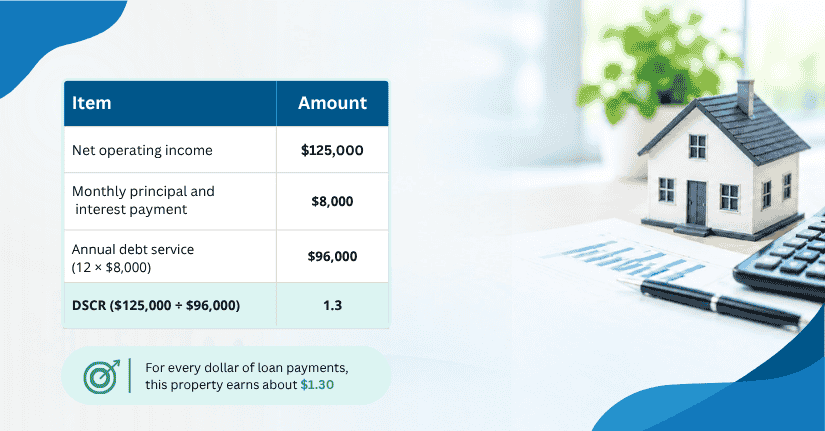
Start with net operating income for a period. Divide it by the debt service for that same period. Easy enough on paper, but the two numbers sit in different corners of your records.
Here’s a quick example with made-up figures. It uses the same illustrative property as our guide to net operating income.
So for every dollar of loan payments, this property earns about $1.30. The extra 30 cents pays for capital projects, reserves, and whatever the owner takes home.
The Top Number: Net Operating Income
NOI starts with effective gross income, meaning rent and other income after vacancy and collection losses. From there, operating expenses are deducted in the form of property taxes, insurance, maintenance, management fees, and utilities. Loan payments, depreciation, capital spending, and income taxes are all below the line. The table indicates where each cost falls and our NOI guide goes into greater detail on every item.
| Item | Where it sits | Why |
| Property taxes | Inside NOI | Operating cost |
| Insurance | Inside NOI | Operating cost |
| Maintenance and repairs | Inside NOI | Routine upkeep |
| Management fees | Inside NOI | Operating cost |
| Utilities | Inside NOI | Operating cost |
| Loan principal and interest | Below NOI | Debt service |
| Depreciation | Below NOI | Non-cash charge |
| Income taxes | Below NOI | Owner-level cost |
| Capital spending | Below NOI | Not an operating cost |
What is recorded in the books is what matters. Say there is $16,000 in the maintenance account, and $10,000 of it paid to repave the parking lot. A full repave is capital spending and belongs below the line, but booked as maintenance it pulls NOI down to $125,000. Put the $10,000 where it belongs and NOI rises to $135,000.
| Scenario | NOI | Debt service | DSCR |
| With the error | $125,000 | $96,000 | 1.30 |
| Corrected | $135,000 | $96,000 | 1.41 |
Nothing about the property changed, and the loan didn’t either. One account code moved the ratio by about 0.10.
The Bottom Number: Debt Service
Debt service is the principal and interest due on the loan for a given period. The two are treated differently in the books, which can be confusing. While interest is an expense, the principal is not; it is simply a reduction of the loan balance on the balance sheet. So when $8,000 goes out to the bank in a month, only a portion of that is recorded as interest on the income statement.
Here is how one month’s payment lands in the books when the lender also collects escrow. Say $10,750 leaves the bank: the $8,000 of principal and interest, plus $2,750 toward property taxes and insurance. If $5,600 of the $8,000 is interest this month, the entry looks like this:
| Account | Debit | Credit |
| Mortgage interest expense | $5,600 | |
| Mortgage loan payable | $2,400 | |
| Escrow deposits held by lender | $2,750 | |
| Cash | $10,750 |
Only the $5,600 reaches the income statement, and it sits below NOI. The $2,400 reduces the loan balance. The $2,750 waits on the balance sheet until the lender pays the tax or insurance bill; the tax and insurance expense itself is recorded in operating expenses, inside NOI. Debt service for the month is the $8,000 of interest and principal, never the full $10,750 that left the bank. The interest and principal split shifts a little every month as the balance falls, which is why the amortization schedule is the source.
One should get the debt service figures from the amortization schedule or the loan statement rather than putting them together from the expense accounts. There are some cases that warrant a more detailed examination:
| Situation | What to do |
| Interest-only loan | Count the interest alone until principal payments begin. |
| Variable-rate loan | Update the figure each time the rate resets. |
| Escrow in the payment | Treat taxes and insurance as operating expenses inside NOI, and keep them out of debt service. Counting them in both places drags the ratio down. |
| Loan terms | Your loan agreement may define NOI and debt service its own way. Read both definitions before you compare numbers. |
How DSCR Differs From Cash Flow
People mix these up, and it’s easy to see why. Both start from the same inputs. Cash flow gives you a dollar amount: take NOI, subtract debt service, then subtract capital spending, tenant improvements, and leasing commissions. DSCR gives you a ratio that shows how many times NOI covers the loan payments.
| DSCR | Cash flow | |
| What it is | A ratio | A dollar amount |
| What it answers | How many times NOI covers the loan payments | How much cash is left after the loan payments |
| Example result | 1.30 | $29,000 before capital spending |
| What it hides | The size of the property | The thickness of the cushion |
In our example, NOI minus debt service leaves $29,000 before any capital spending. A 1.30 DSCR tells the same story in a different shape. Here’s the catch. A small building and a large one can both land on 1.30 while producing very different dollars. The ratio shows how thick the cushion is, and the dollars show how big it is. You need both.
Match the Period and the Basis
A ratio only works when both numbers cover the same stretch of time. Divide a quarter of NOI by a full year of payments and you get a number that means nothing. Pick the trailing twelve months for both, or the same single month for both.
The accounting basis matters just as much. Say NOI follows the accrual basis while debt service follows cash payments. A payment that clears the bank on the 2nd instead of the 30th can shift a figure from one period to the next. Choose one basis, use it every time, and write down which one you chose.
Five Ways the Books Distort DSCR
None of these looks serious on its own. Add them together, though, and they can move the ratio further than any real change in the property.
Capital Spending Booked as Repairs
What it does. Capital work parked in maintenance inflates operating expenses and shrinks NOI. That makes the ratio read lower than the property truly earns. Our repaving example shows how large the swing can get, and a single invoice caused all of it.
The fix. Set a written dollar threshold for capital items, and look over any large repair entry each month before you close.
Loan Payments Booked as Expenses
What it does. Sometimes the whole mortgage payment lands in an operating expense account. NOI then drops by principal and interest together, and the same payment shows up again as debt service. The ratio takes the hit twice.
The fix. Split every payment into principal and interest using the loan statement. Map the loan accounts below the NOI line.
Escrow Counted Twice
What it does. Taxes and insurance paid through escrow appear in operating expenses, and they also sit inside the loan payment. Debt service looks too high, so the ratio looks too low.
The fix. Pull the escrow portion out of each payment and count it once, as an operating expense.
Income That Never Reaches the Report
What it does. Some income never gets billed, such as an expense recovery or a late fee the lease allows. Unbilled, it never reaches NOI, so the ratio understates the property, and the report gives no hint that anything is missing.
The fix. Compare billing to lease terms each month, and hunt for charges that should have posted but didn’t.
Mismatched Periods or Bases
What it does. Take NOI from one period and pair it with debt service from another, or an accrual number with a cash one, and the resulting ratio will not be comparable to that of last quarter or last year.
The fix. Set your basis and period once, apply them consistently, and note them in the report.
Then have a look at the pattern. You will find the trouble was never in the formula; nearly all of the items above are due to a coding or timing error.
A Month-End Check for the Inputs
After the books close each month, run through this list.
- Tie the loan balance. The balance in your books should match the loan statement to the dollar.
- Check the split. Make sure each payment divides into principal and interest, and that escrow sits outside debt service.
- Scan repairs. Look for capital items hiding in maintenance.
- Compare billing with leases. Watch for missing recoveries and fees.
- Recalculate. Work out NOI and debt service for the same trailing twelve months, and note the basis.
Then put the result on a one-page summary that shows the ratio and what moved since last month. When the inputs are clean, the ratio takes about a minute to compute.
Frequently Asked Questions
What is the debt service coverage ratio for real estate?
It compares a property’s net operating income with its scheduled loan payments for the same period. A ratio of 1.0 means income just covers the payments. Anything higher means more cushion.
How do you calculate DSCR?
Divide NOI by total debt service for the same period. With $125,000 of NOI and $96,000 of debt service, the DSCR comes to 1.30.
What does a DSCR below 1.0 mean?
NOI falls short of the loan payments, so the owner has to cover the gap from other cash. A ratio under 1.0 calls for a close look at both income and expenses.
What counts as debt service?
Scheduled principal and interest on the loan. Taxes and insurance paid through escrow stay out of it, because they are already counted in operating expenses. It is well to read the loan agreement since it could put a different definition on the term.
Why can two people get different DSCRs for the same property?
Usually the division is the same and the inputs are different. Someone might apply a different accounting basis or period and handle capital spending in another fashion, and the loan agreement may define NOI in its own way. Pick one method and stick with it.
The Bottom Line
The debt service coverage ratio for real estate is simple division with demanding inputs. NOI must come from correctly coded income and expenses. Debt service has to split into principal and interest, with escrow kept apart. Match the period and the basis, and the ratio holds steady month after month.
If you’d like the books behind your ratio coded and reconciled the same way every month, Outsourced Bookkeeping has 20+ years in business (est. 2004) and 75+ accountants on staff. Our real estate accounting services cover monthly bookkeeping, reconciliations, and reporting for property owners and managers. Book a conversation and we’ll look at your books with you.
About the Author