

Intercompany Transactions for Real Estate Groups
Intercompany transactions are payments, charges, and loans between entities that share an owner. In a real estate group, they happen all the time. The management company bills each property a fee. One property pays a bill that belongs to another. Cash moves between bank accounts. Each move must show up in both sets of books, in equal and opposite amounts. When it doesn’t, balances disagree and group reports go wrong. This guide covers the types, the entries, the month-end match, and the usual mistakes. It covers the accounting side only.
Key Takeaways
- Intercompany transactions are dealings between entities in the same group.
- Record every one in both entities, using “due to” and “due from” accounts.
- The two balances must match to the dollar.
- When you combine entities for reports, the matching balances cancel out.
- A monthly match of every pair catches errors before they grow.
What Intercompany Transactions Are in a Real Estate Group
Few real estate groups run as one company. Most have several entities, and each keeps its books. A typical set looks like this:
- A holding company that owns the property entities.
- A management company that runs the buildings and bills fees.
- Property entities, often one for each building.
- A development or services entity, in some groups.
Any deal between two of them is intercompany. Rent from a tenant is not intercompany, because the tenant is outside the group. The test is simple: both sides belong to the same group.
We use a made-up group in this guide. It has a holding company, a management company, and three property entities, called A, B, and C.
Why Property Groups Struggle With Intercompany Transactions
The idea is simple. Doing it well gets harder. Four things get in the way:

- Many entities. Every new building often brings a new entity and a new set of books.
- Shared bank accounts. When rent and bills share one account, it is hard to see which entity owns which dollar.
- Different hands. Several people post entries, and each sees only one entity.
- Timing. One side posts on the 31st. The other posts on the 2nd.
None of these is hard on its own. Together, they let balances drift. A steady routine stops the drift before it grows.
The Five Common Types
Most intercompany activity in a property group falls into five buckets.
| Type | What happens | Made-up example |
| Management fees | The management company bills each property | Property A owes $3,000 for the month |
| Shared costs | One entity pays a bill for others | A’s bank account pays an $1,800 software bill for B |
| Loans and advances | One entity lends cash to another | The holding company lends C $20,000 for a roof repair |
| Pooled cash | Several entities use one bank account | Rent from A and B lands in one account |
| Shared payroll | The management company pays staff and bills the properties | Site staff cost splits among three buildings |
Each row creates a balance between two entities. That balance is what you track.
How to Record an Intercompany Transaction
Use mirror entries. One entity records a debt it owes. The other records a debt it holds as an asset. Accountants name these accounts “due to” and “due from.”
Start with the management fee. Property A owes the management company $3,000.
| Entity | Debit | Credit | Amount |
| Property A | Management fee expense | Due to management company | $3,000 |
| Management company | Due from Property A | Management fee income | $3,000 |
Later, Property A pays. Both sides record the cash.
| Entity | Debit | Credit | Amount |
| Property A | Due to management company | Cash | $3,000 |
| Management company | Cash | Due from Property A | $3,000 |
Now a shared bill. Property A’s bank account pays an $1,800 software bill that belongs to Property B.
| Entity | Debit | Credit | Amount |
| Property A | Due from Property B | Cash | $1,800 |
| Property B | Software expense | Due to Property A | $1,800 |
Notice the pattern. Each entry has a twin. The “due from” on one side always matches the “due to” on the other.
Track Who Owes Whom
Now say it is month-end and Property A has not paid the fee yet. The group has two open balances, and a small matrix keeps them in view.
| Entity | Due from others | Due to others |
| Property A | $1,800 (from B) | $3,000 (to management company) |
| Property B | $0 | $1,800 (to A) |
| Management company | $3,000 (from A) | $0 |
| Group total | $4,800 | $4,800 |
The two totals match. That is the first test: if they differ, an entry is missing on one side. Matching totals do not prove every pair is right, though. If Property B had booked its $1,800 as owed to the management company instead of to Property A, both totals would still be $4,800. So match each pair as well, as the month-end check below does.
What Happens When You Combine the Entities
Many groups combine their entities for reports. When they do, the due to and due from balances cancel out. The entries that remove them are called intercompany eliminations. So do the fee income and the fee expense. Without that step, the group looks bigger than it is.
Take the $3,000 fee. The management company shows it as income. Property A shows it as an expense. In the combined report, neither line stays. No outsider paid the group. The money only moved between two of its own entities. Your $4,800 of open balances cancel the same way.
Whether you combine, and how, depends on your reporting needs and your ownership setup. Check the approach with your accountant first.
How Intercompany Transactions Touch NOI
At the property level, a management fee is an operating expense. It sits inside NOI. A loan from another entity is different. The loan itself sits on the balance sheet, and any interest on it sits below NOI, like any other debt.
Mix them up, and NOI moves for no real reason. A fee booked as a loan makes NOI look better than it is. Treat a transfer as an expense, and NOI looks worse. Our guide to net operating income shows what sits above and below the line.
Five Intercompany Mistakes That Skew the Books
Most are small slips. Across several entities, they add up fast.
Recording One Side Only
What it does. Property A books the $3,000 fee. The management company never books the income. Now the two balances disagree. Group totals sit $3,000 off, and nobody can say why. With several entities, one missing entry can take hours to find.
The fix. Post both sides on the same day. Use a standard template for each type of transaction, so the twin entry is never left out.
Posting Transfers to Income or Expense
What it does. Cash moves from Property B to Property A, and someone books it as income in A. Income is now higher than it should be. NOI rises, though no outsider paid anything. The same slip on B’s side, booking the transfer out as an expense, makes B’s NOI look worse for no real reason.
The fix. Run every transfer through “due to” and “due from.” Keep income and expense accounts for real activity with outsiders.
Mismatched Amounts or Dates
What it does. Property A posts the $3,000 on the 31st. The management company posts it on the 2nd of the next month. At month-end, the balances disagree. Amounts drift the same way. The management company bills $3,000, Property A disputes $200 of it and books $2,800, and nobody tells the other side. Small gaps like this make a clean match look impossible.
The fix. Set one cutoff date for all entities. Both sides post to the same month, even when the cash moves later. When the two sides disagree on an amount, agree the figure first, then correct whichever side is wrong, so both books carry the same number.
Skipping the Allocation of Shared Costs
What it does. One property carries the whole shared bill. Its statement looks worse. The other properties look better than they are. Owners then judge buildings on numbers that don’t reflect real costs.
The fix. Choose an allocation basis, such as units, square feet, or headcount. Write it down. Apply it the same way each month, and bill each entity its share.
Letting Balances Age
What it does. Balances sit for years with no plan to settle them. Nobody knows which are real, which are old, and which are wrong. Loans between entities blur into the rest of the ledger.
The fix. Set a settlement schedule. Review the age of each balance every quarter. For loans, keep a short written note of the amount, the date, and the repayment plan.
A Month-End Intercompany Check
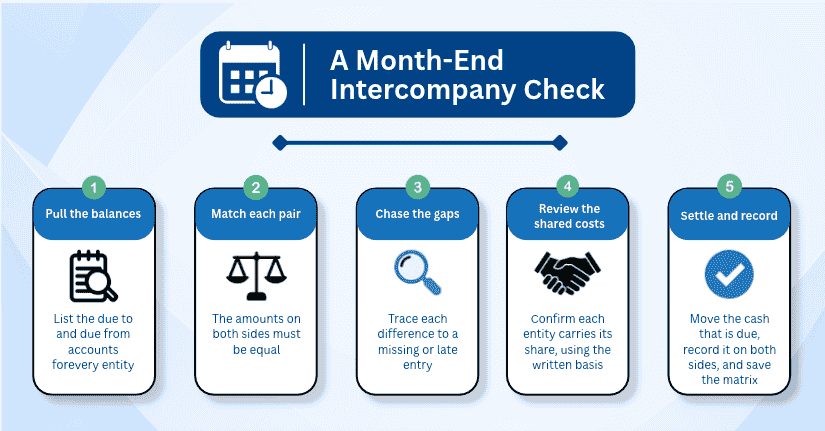
Then note anything unusual for the owner. The check takes minutes when you keep it up every month. It takes days when you wait for year-end.
Old balances also tend to surface at the worst moment: an audit, a refinance, or the sale of one building out of the group. Whoever reviews the books will ask what each balance is and whether it will ever be paid. A balance nobody can explain has to be traced entry by entry, sometimes years back, while the deal waits.
Frequently Asked Questions
What are intercompany transactions?
They are payments, charges, and loans between entities in the same group. In real estate, common examples are management fees, shared costs, loans between entities, and pooled cash. Both entities record each one.
What are due to and due from accounts?
They hold the debt between two entities. The entity that owes money records “due to.” The entity waiting for payment records “due from.” The two amounts must match.
How do you reconcile intercompany balances?
Match each pair of balances. Start with the “due from” on one side and the “due to” on the other. If they differ, trace the gap to a missing, late, or wrong entry. Fix it and match again.
Do intercompany transactions affect NOI?
Some do. A management fee from the group’s own management company is an operating expense, so it reduces the property’s NOI just like an outside manager’s fee would. Transfers and loans between entities do not belong in NOI at all. Book one as income or expense, and NOI moves for no real reason.
Why do intercompany balances cancel out in combined reports?
Both sides belong to the same group. The money moved from one entity to another, so the group has no real income, expense, or debt from it. Cancelling the balances shows the group as one business.
The Bottom Line
Intercompany transactions are simple when you treat them as pairs. Record both sides. Use “due to” and “due from.” Match the totals every month. Then the group reports tell the truth, and the owner can trust the numbers.
If you run several entities and the balances never match, Outsourced Bookkeeping can help. We have 20+ years in business (est. 2004) and 75+ accountants on staff. Our real estate bookkeeping services cover monthly bookkeeping, reconciliations, and reporting for property owners and managers, including multi-entity groups. Book a conversation and we will look at your books with you.
About the Author
