

Retainage Accounting for Contractors: Receivable, Payable and Journal Entries
Retainage reduces what a contractor collects now. It never reduces what the contractor earns. That idea is the core of retainage accounting, and it’s easy to get wrong on the books.
The reason is simple. Retainage sits on both sides of the balance sheet. The owner holds back part of what they owe you, and you hold back part of what you owe your subcontractors. Record one side without the other, or post either side to the wrong account, and your receivables, payables and job results all drift.
This guide is for the controller or bookkeeper who records retainage every month and needs it right. It covers what retainage is, when it counts as a receivable, how to book both sides and how to tie it out. We stay on the accounting. The legal rules around retainage are a separate topic.
Key Takeaways
- Retainage delays cash. It doesn’t change what you earned or what the job cost.
- Retainage receivable is the owner’s withheld money where only the payment date is left. If something else still has to happen first, the balance is conditional.
- Retainage payable is the matching amount you hold back from your subcontractors.
- Track retainage in its own aging by job, and tie it to the ledger at every month end.
- Keep release dates visible, because the last invoice on a job is easy to forget.
What Is Retainage?
Retainage is a part of each progress payment that an owner withholds until the owner accepts the job. You never assume the percentage. Read the contract, because it sets the number. This guide uses 10% in its examples, and that figure is made up.
You bill retainage as part of progress billing, which charges the owner for work completed against the schedule of values. We won’t repeat that process here.
The work behind retainage is earned revenue that you have billed and not yet collected. You did the job. The cash waits.
That gap matters more as you add jobs. One job’s retainage looks small. Several jobs at once can tie up a large sum of cash you have already earned, while your income looks healthy. A bookkeeper who tracks retainage well can show the owner of the business exactly how much is waiting and when it should arrive.
It runs the other way too. When you withhold part of a subcontractor’s bill, you owe that money later, not now.
If you also know property management, don’t mix this up with a security deposit. A security deposit is tenant money held in trust. Retainage is a withholding on a progress payment, and property management trust rules don’t apply to it.
How Retainage Builds Over a Job
Retainage grows a little with every bill. Here’s a made-up job. You bill the owner $100,000 a month for four months, and the contract holds back 10% each time.
|
Month |
Billed | Held This Month | Total Held |
| 1 | $100,000 | $10,000 | $10,000 |
| 2 | $100,000 | $10,000 | $20,000 |
| 3 | $100,000 | $10,000 | $30,000 |
| 4 | $100,000 | $10,000 | $40,000 |
After four months, you have billed $400,000 for work you did. If the owner paid every bill, you have collected $360,000. The other $40,000 sits in retainage, waiting for the release.
Notice the shape. In this example, the balance only goes up while the job runs, then drops to zero at release. That’s why a job near the finish line can show a large retainage balance next to a small monthly bill. Both are normal, and both need watching. Real contracts can differ: some reduce the percentage once the job reaches a milestone, and some release retainage in stages. The contract sets the release terms.
Retainage Receivable: Unconditional or Conditional
Contractors call this balance retainage receivable, so this guide does too. Whether it truly is a receivable comes down to one test. Is your right to the money unconditional?
It’s a receivable when the only thing left is waiting for the payment date. Time is the only gap.
It’s different when the right depends on something else, such as completion or punch-list sign-off. Under ASC 606, the revenue standard, that balance is a contract asset. It moves to receivables once the condition is met. On a job billed ahead of the work, it reduces billings in excess of costs and estimated earnings (a contract liability) instead.
| What the contract says | How to treat it |
| Only the payment date is left | Retainage receivable |
| Completion or punch-list sign-off still stands in the way | Conditional retainage, until the condition is met |
Here’s a made-up case. A contract releases retainage 30 days after the owner accepts the work. The owner accepted the job yesterday. Only time is left, so the balance is a receivable. If the owner hasn’t signed off on the punch list, a condition remains, and the balance isn’t a receivable yet.
Retainage Payable
Now look at the other side. A subcontractor bills you $40,000, and your agreement withholds 10%, which is a made-up figure. You owe the subcontractor $36,000 now and $4,000 later. The $4,000 sits in retainage payable, which is a liability.
Your cost doesn’t change. The full $40,000 is job cost for the work the subcontractor has done.
Keep retainage payable apart from regular accounts payable. Mixed together, your payables look larger than what you owe this month. They also hide what you owe at the end of the job.
Track the balance by subcontractor as well as by job. A subcontractor who works on three of your jobs can have three small retainage balances. Add them up, and you see the full amount you owe that one company when the work ends.
Journal Entries: A Worked Example
Everything here is made up. Take a $100,000 progress billing with 10% retainage. Assume the contract leaves only the payment date, so the balance is a receivable. If your contract holds retainage until completion, the entries have the same shape, but the $10,000 stays conditional until that condition clears.
First, the owner side when you bill.
| Account | Debit | Credit |
| Accounts receivable | $90,000 | |
| Retainage receivable | $10,000 | |
| Contract revenue | $100,000 |
Some contractors credit a billings account instead of contract revenue. Our WIP accounting guide explains how that fits with the rest of the books.
Next, the subcontractor side. A subcontractor bills $40,000 with 10% retainage.
| Account | Debit | Credit |
| Job cost | $40,000 | |
| Accounts payable | $36,000 | |
| Retainage payable | $4,000 |
Look at what didn’t move. The cost is the full $40,000, and the amount earned is the full $100,000. Retainage delays the cash, not the revenue or the cost.
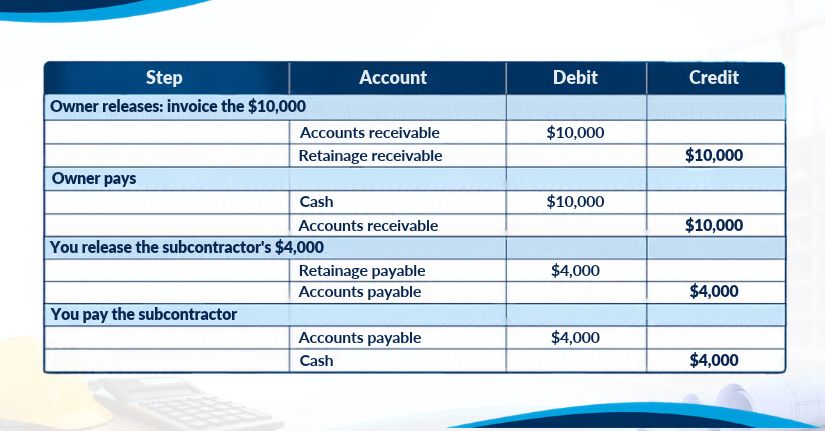
At release, the entries run in two steps on each side.
Tracking and Tying Out Retainage
In retainage accounting, booking the entries is the easy part. Keeping the balances right over months and across jobs takes three habits.
Keep a Separate Aging by Job
Track retainage in its own aging, job by job. Mixed into normal AR, it makes the aging look older than it is. It can also hide money that won’t arrive for months. A $10,000 balance on a job that finished last week isn’t a collection problem. It’s money waiting for its date. Each month, ask which jobs have finished and which balances still wait.
Run the Month-End Tie-Out
For each job, the retainage held on the latest pay application should match the general ledger. The total by subcontractor should match retainage payable.
Here’s a made-up tie-out.
| Job | Held on Latest Pay Application | Ledger | Difference |
| Job A | $10,000 | $10,000 | $0 |
| Job B | $22,500 | $21,000 | $1,500 |
| Job C | $8,000 | $8,000 | $0 |
Job B is the one to chase. Likely causes are an application that changed after posting, an entry that went to the wrong account, or a retainage rate that stepped down partway through the job while the ledger kept posting at the old rate. Find the cause before you close the month.
When a job doesn’t match, work through these steps:
- Pull the latest pay application and note the retainage it shows as held.
- Pull the ledger detail for that job and add up each retainage entry.
- Look for an entry posted to the wrong account, or one that’s missing.
- Fix the entry, then check that the difference is zero.
- Write down what caused it, so the same mistake doesn’t repeat next month.
Keep Release Dates Visible
List the release date for every job, and look at that list each month. The last invoice on a job is easy to forget. Once the work looks finished, attention moves to the next job. A release date you can see keeps that money from sitting uncollected.
Releasing and Billing Retainage
When the condition is met and the date arrives, the steps are short.
- Move the amount from retainage receivable to accounts receivable.
- Invoice the owner.
- Record the cash when it arrives.
The subcontractor side mirrors it. Move the amount from retainage payable to accounts payable, then pay it.
Check the contract before you move anything. The release terms, not the job’s finish date, decide when the balance becomes billable.
Then confirm four things before you invoice the release. First, the release terms in the contract allow billing now. Second, any condition, such as punch-list sign-off, has cleared. Third, the amount you plan to bill matches the ledger for that job. Fourth, the owner’s records show the same figure. A mismatch at this stage slows the payment, and an old balance gets hard to explain a year later.
Where Retainage Goes Wrong
A few mistakes show up again and again.

Each one is easy to catch if you run the month-end tie-out and keep the release list in front of you.
Disclosing Retainage
For retainage in receivables, contractors disclose the amounts, the part they expect to collect after one year and, where practicable, when they expect to collect it. RevenueHub’s summary points to ASC 910-10-50-7 and a FASB staff paper on the topic. Your CPA sets the exact wording for your financial statements.
Frequently Asked Questions
Is retainage an asset or a liability?
It can be either, depending on whose money is held back. Retainage receivable is an asset, because the owner owes you. A liability sits on the other side: retainage payable, because you owe your subcontractor.
Is retainage revenue?
The work behind it is. You record the full amount you earned, even when part of it waits. In the example above, you record $100,000 as earned while $10,000 of it stays uncollected. Retainage changes when you collect, not when you earn. If you net it out of revenue, job profit looks lower than it really is, and your results won’t match the work.
How do you record retainage in accounting?
On the owner side, debit accounts receivable for what’s due now, debit retainage receivable for what’s held and credit revenue for the full amount. For a subcontractor’s bill, debit job cost for the full bill, credit accounts payable for what’s due now and credit retainage payable for what’s held. At release, move each balance to accounts receivable or accounts payable, then settle it.
How do you bill for retainage on an AIA pay application?
The application lists the contract in line items. For each line, it shows work from earlier applications, work this period and stored materials, and it totals the retainage held. While the job runs, the amount held comes off what’s due. When the owner releases retainage, the amount held drops, and the amount due rises by the same figure. Our AIA billing guide walks through the application in full.
When does retainage become a receivable?
It becomes a receivable when your right to it is unconditional, meaning only the payment date is left. If it depends on completion or punch-list sign-off, it stays conditional until that happens. Then it moves to receivables.
Final Thoughts
Retainage looks like a small line on a pay application. On the books, retainage accounting touches receivables, payables, job cost and the month-end tie-out. Hold on to the main point: it reduces what you’re paid now, never what you earn. Book both sides, keep them apart from regular AR and AP, and keep release dates where you can see them.
A short monthly check keeps the work simple:
- Does each job’s retainage sit in its own aging?
- Does the ledger match the latest pay application?
- Does retainage payable match the total by subcontractor?
- Does every job have a release date on the list, with the next one marked?
If all four answers are yes, your retainage is in good shape.
Need a hand keeping retainage tidy across your jobs? Set up a short call with our team, or read more about our construction accounting services.
About the Author