

Schedule of Values: What It Is and How to Build One
A schedule of values (SOV) is the agreed breakdown of a construction contract sum into billable line items, and it is the basis for every progress payment on the job. It is a billing document, not a cost budget.
That distinction is the whole story. The schedule of values is what you agreed to bill against. The cost budget is what the job actually costs. They are built by different people for different reasons, they rarely map line for line, and almost every argument on a pay application starts in the gap between them.
What a Schedule of Values Actually Is
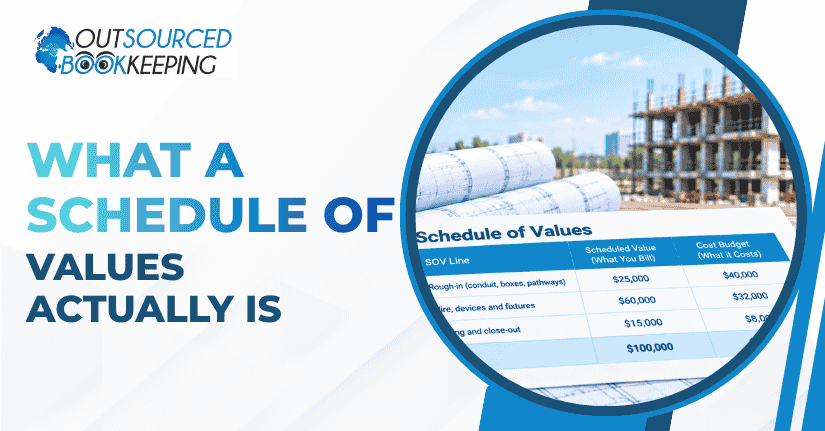
An SOV (Schedule of Values) breaks the total contract amount into line items you bill against as work progresses. Each line carries a scheduled value: the portion of the contract allocated to that piece of work. As work gets done, the contractor applies a percent complete to each line and bills accordingly.
The document is negotiated with the owner or the owner’s representative before the first payment application. Once agreed, it becomes the fixed structure for every later application, and the continuation sheet attached to each pay application is just a line-by-line update of percent complete and amount billed to date.
Under ASC 606, revenue on a construction contract is generally recognized over time as work progresses. Most contractors measure that progress with the cost-to-cost input method: actual costs incurred divided by total estimated costs. That’s a cost estimate, and it has nothing to do with what’s billed on the SOV.
- The SOV bills each line at the percent complete agreed with the owner for the work in place. It never looks at cost.
- The revenue recognized under ASC 606 often differs from the amount billed on the SOV for the exact same job. That’s not a bug in the system and it’s why this entire guide exists.
A Quick Example: The $100,000 Electrical Job
Say you contract to rewire a commercial building for $100,000. Your internal cost budget is $80,000, so the job carries $20,000 of margin. The SOV agreed with the owner has three lines, and your budget carries the same three scopes at cost:
| SOV line | Scheduled value (what you bill) | Cost budget (what it costs) |
| Rough-in (conduit, boxes, pathways) | $25,000 | $40,000 |
| Wire, devices and fixtures | $60,000 | $32,000 |
| Testing and close-out | $15,000 | $8,000 |
| Total | $100,000 | $80,000 |
The owner wanted the value weighted toward finished, visible work, so rough-in, the most labor-heavy scope, carries a smaller share of the contract than of the cost.
In Month 1 the crew completes half the rough-in. Every dollar counted is installed work.
| Month 1 | How it’s calculated | |
| ASC 606 revenue | $25,000 | $20,000 cost incurred ÷ $80,000 total estimated cost = 25% complete; 25% × $100,000 |
| SOV progress bill | $12,500 | Rough-in 50% complete × $25,000 scheduled value |
Nobody disputes the progress: both sides agree the rough-in is half done. The $12,500 gap exists only because the two documents weight the same work differently. It sits on the balance sheet as costs and estimated earnings in excess of billings (a contract asset under ASC 606), the position contractors call underbilling. It unwinds later, when the wire, devices and fixtures line bills $60,000 against $32,000 of cost. Neither number is wrong. They measure two different things.
Who Actually Signs Off on It
The owner, or the owner’s architect or construction manager, reviews and approves the SOV before the first billing cycle. That approval matters more than it sounds: once both sides agree, the SOV becomes the reference point for every later argument. A contractor can’t unilaterally decide a line item was worth more than agreed, and an owner can’t suddenly demand a different breakdown mid-job without reopening negotiations, which neither side wants.
That is why the structure has to be right before the first application. Fixing it after the third or fourth is far harder.
The SOV Is a Billing Document, Not a Cost Budget
This distinction matters most, and it’s the one most explanations skip entirely.
The owner negotiates the SOV to develop a fair, transparent structure for billing progress. The owner wants line items clear enough to judge percent complete without a fight every month; the contractor wants line items that support reasonable cash flow as work progresses. It is not organized around the contractor’s internal cost structure.
The cost budget is internal. Estimators, project managers and cost accountants build it around cost codes, phases or work packages, to control and forecast cost, not to bill.
Here’s a side-by-side look at how differently these two documents actually work:
| Feature | Schedule of Values | Cost Budget |
| Who builds it | Negotiated with the owner | Built internally by the project team |
| Purpose | Structures progress billing | Tracks and controls actual cost |
| Organized around | Owner-facing scopes of work | Cost codes, phases, work packages |
| Changes after signing | Requires owner agreement | Can be updated internally at any time |
| What happens when it’s wrong | Billing disputes, challenged pay applications | Missed cost overruns, poor forecasting |
When the two structures don’t agree, every billing cycle turns into an act of translation. The project accountant has to determine which part of actual cost supports the percent complete claimed on each SOV line, and when that translation gets fuzzy, disputes follow.
How a Line Item Actually Gets Built
Every line on an SOV is more than a description and a dollar figure. A well-constructed line bundles direct labor, materials, subcontract packages, equipment or general conditions assigned to that scope, plus overhead and profit for that portion of the work.
The real skill in building a usable SOV is picking the right level of detail.
- Lines too broad, like a multi-million dollar “Building Structure” line, turn percent complete into a matter of opinion, one that gets challenged every time.
- Lines too fine turn the document into a paperwork burden, where every small change needs its own approval and the monthly pay application becomes a negotiation over a dozen tiny percentages.
Good practice sits in the middle: lines big enough to mean something, specific enough that both sides can agree on progress. Trade packages, major building systems and distinct phases of work tend to work better than either extreme.
A Simple Test for Line Size
Ask whether a reasonable person walking the site could look at a particular line item and estimate its percent complete within 10 percentage points based only on what they can see.
- If yes: The line is correctly sized.
- If two people land 20 points or more apart: The line is too broad, creating a gap where disputes will eventually show up.
Cost Codes and SOV Lines Aren’t the Same Structure
Cost codes are built around how the contractor buys labor, materials and subcontracts and measures its own performance. SOV lines are built around how the owner wants to see the work broken down for payment.
These two systems serve different users and rarely map one-to-one: a single SOV line can pull cost from multiple cost codes, and one cost code can support work tied to more than one SOV line. The mismatch shows most at close-out, when the final cost report has to be explained line by line against the final billed amounts.
The practical fix is easy to state but hard to sustain: someone must keep a working bridge between the two structures for the life of the job. Without that bridge, percent-complete claims get harder to defend and variance explanations get harder to produce.
That’s one reason disciplined job costing in construction accounting matters. That discipline has to hold up month after month, not just at the start of the job when everyone is watching closely.
A Worked Example
Take a commercial interior fit-out with a contract sum of $1,200,000. Here’s the SOV the parties agreed on:
| Line | Description | Scheduled Value |
| 1 | Mobilization and General Conditions | $90,000 |
| 2 | Demolition and Preparation | $75,000 |
| 3 | Mechanical | $280,000 |
| 4 | Electrical | $210,000 |
| 5 | Interior Finishes | $320,000 |
| 6 | Flooring | $110,000 |
| 7 | Final Clean and Close-Out | $45,000 |
| 8 | Allowances | $70,000 |
| Total | $1,200,000 |
Behind that SOV sits the contractor’s cost budget, organized differently. The $280,000 Mechanical line is carried internally as four cost codes with a combined budget of $210,000. Electrical splits the same way into rough-in, fixtures and low-voltage; Interior Finishes into drywall, paint, millwork and ceilings.
At the third application, the superintendent reports Mechanical at 40% complete. The ductwork is mostly up, and it is what anyone walking the floor sees. The project accountant checks the claim against the cost codes:
| Mechanical cost code | Budget | Installed cost to date | Complete |
| Ductwork | $70,000 | $42,000 | 60% |
| Equipment (rooftop units) | $95,000 | $0 | 0% |
| Controls | $30,000 | $0 | 0% |
| Testing and commissioning | $15,000 | $0 | 0% |
| Mechanical total | $210,000 | $42,000 | 20% |
A 40% claim bills $112,000 on the line. The cost codes support 20%, or $56,000. The ductwork is the visible part of the line, but the rooftop units carry almost half its cost and none are set yet. That $56,000 is the gap in dollars: a claim that is easy to make from a site walk and hard to defend in an owner’s review.
The SOV line can’t show that. The cost budget can.
Where Schedules of Values Go Wrong
Most billing problems on a job can be traced directly to how the SOV was built or maintained afterward. Here are the patterns that show up most often.
The Front-Loaded SOV
Early lines such as mobilization, general conditions or submittals are given a bigger share of the contract sum than of the cost budget. Every line can then be billed at an honest percent complete, yet the job still bills ahead of its own cost curve from the first application, because the weighting was set that way at approval. It’s a structural choice, not something that happens to the job later.
Where you’d catch it: at SOV approval, set each line’s share of the contract sum beside its share of the cost budget. Early lines carrying a visibly larger share of the contract than of the cost are the tell.
The Change Order With No Line to Hang It On
Scope gets directed. Work gets started. The SOV has no scheduled value sitting there to go with it. The change either messes up an existing line or requires a brand-new line. That new line has to be negotiated with the owner while work is already underway, just when neither side wants to reopen the billing system. The longer that change stays unpriced and unscheduled, the more difficult it becomes to place cleanly inside the SOV.
Where you’d catch it: at month end, list every change the field is building and check that each one has a scheduled value on the SOV. Directed work with costs posting against it and no SOV line behind it is the tell.
Lines Too Coarse to Bill Honestly
One big line covering a large part of the work turns percent complete into a judgment call, and a judgment call is what an owner’s rep is there to challenge.
Where you’d catch it: in the pay-application history. A line the owner’s rep marks down month after month is too broad for both sides to agree on.
The SOV Agreed After Work Already Started
If the billing system is finalized only after mobilization or early work has started, the first application ends up negotiated against work already in place, which creates a retrospective argument over how much of that early work belongs to which line, and at what value.
Where you’d catch it: compare the date the SOV was approved with the date of the first cost posted to the job. Costs dated before approval mean the first application will be argued backwards.
Stored Materials With Nowhere to Sit
Materials are delivered to site but not yet installed, and the SOV has no provision for them. The contractor either bills them as installed progress, overstating the work in place, or leaves them unbilled and finances them in the meantime. Where the contract allows it, stored materials are billed separately, supported by invoices and proof of delivery, and move into work completed as they are installed.
Where you’d catch it: at month end, compare what is delivered and uninstalled on site with the contract’s stored-materials terms. Material on site with no provision to bill it under is the tell.
(Where the owner takes control of a significant third-party-supplied item well before it is installed — elevators, switchgear, a generator — ASC 606 has a specific treatment: the cost comes out of the progress calculation, and revenue on that item is recognized at cost, with no margin.)
Frequently Asked Questions
Is an SOV the same as a cost budget?
No. The SOV is the billing system agreed upon with the owner. The cost budget is an internal document used to control and monitor actual costs. They perform different functions and are rarely identical in structure.
When should the SOV be agreed?
The SOV should be agreed upon before the first progress billing application is made, because once the work begins, negotiating the structure becomes much harder and more contentious.
What happens when a change order comes in?
The change needs a place to go inside the SOV. If no line fits, you have to add a new one or adjust an existing line by agreement. Leave the change unscheduled, and it creates ongoing billing friction that keeps compounding.
The Bottom Line
The schedule of values sets how progress is measured and how every payment application is structured for the life of the contract. Treat it as an administrative formality, or assume it will line up with the internal cost budget on its own, and that is where the avoidable arguments start.
A clear, well-structured SOV won’t stop every dispute. It makes disputes narrower, more specific and easier to settle, and the contractors who bill cleanly are usually the ones who treated it as a serious commercial document from day one.
If your team is struggling with progress billing, job cost alignment, or the practical accounting sitting behind an SOV, specialized construction accounting services can help. We keep the numbers consistent and the applications defensible.
Set up a conversation to talk through how your current billing and cost structures are actually working.
About the Author
