
How to Set Up a Property Management Chart of Accounts (with Template)
A messy chart of accounts is one of those problems that looks harmless right up until it isn’t. An owner asks why their statement is different from what they expected, and all of a sudden, no one can find where a repair bill actually got coded. That’s usually the moment someone finally sits down and fixes the property management chart of accounts they’ve been putting off for months.
So, what is a chart of accounts? Simply put, it is a list of all of the financial accounts necessary to document the income, expenses, assets, liabilities, and equity across your rental portfolio.
Consider it a digital filing system. A strong chart of accounts ensures nothing is misplaced and that every dollar that moves through your business has a specific drawer where it belongs.
What Is a Property Management Chart of Accounts?
While they follow the same structures, a general business chart of accounts and a property management chart of accounts are not the same.
Property management involves tasks other businesses likely wouldn’t deal with. These tasks include managing tenant security deposits, which legally can’t be mixed with operating funds, managing income and expenses per property, and managing owner distributions that one can trace to individual buildings.
An efficiently designed chart of accounts shows owner statements, organizes data for tax purposes, and indicates which properties are making money and which properties are bleeding money.
Self-managed landlords need tools like these just as much as larger property management companies that manage hundreds of properties. The need for clean categorization remains the same, though it may appear different depending on the scale of management.
The Five Core Categories
Every chart of accounts, property management or otherwise, breaks down into five main categories. Property managers like to use a block numbering system, grouping each category into its own number range, which keeps things organized as the portfolio grows.
- Assets (1000s)– what you own: bank accounts, buildings, equipment
- Liabilities (2000s) – what you owe: accounts payable, security deposits held, mortgages
- Equity (3000s)- owner contributions, distributions, retained earnings
- Revenue (4000s)- rent, late fees, pet rent, application fees
- Expenses (5000s)– repairs, insurance, property taxes, management fees
Each of these account types can have sub-accounts. For a property management company with multiple properties, each account can contain a property code to help you track income and expenses down to the individual building, not just the business as a whole.
Step-by-Step: Building Your Chart of Accounts

Step 1: Choose Your Accounting Method and Tools
Most small landlords use cash basis accounting, which records income and expenses when cash is received or paid. Larger landlords may adopt accrual accounting, where transactions are recorded when they are earned or incurred.
In the earlier stages of property rentals, landlords can manage accounting sufficiently using spreadsheets. Property management software, such as AppFolio and Yardi, comes with built-in chart of accounts structures designed specifically for trust accounting and per-property tracking, which saves a lot of setup time later.
Step 2: Set Up Your Numbering Hierarchy
You will need to define how you want your accounts grouped before you set any up. For example, you may want to designate the 1000s for assets, the 2000s for liabilities, and so on. This will help you maintain an organized chart of accounts and will enable sortability and scalability for reports as your property management operations grow.
Step 3: Build the Core Accounts
Here’s a practical starting structure:
Assets
- 1010: Operating Checking Account
- 1020: Reserve or Savings Account
- 1030: Trust/Escrow Account (Security Deposits)
- 1220: Buildings
- 1240: Accumulated Depreciation
A note on that depreciation account specifically: residential rental property gets depreciated over a 27.5-year straight-line schedule under IRS rules, starting the year the property is placed in service, not the year the first tenant moves in. Land itself can’t be depreciated; only the building and capital improvements to the building can be.
This distinction trips up a lot of new landlords, and it’s detailed in IRS Publication 527, Residential Rental Property, the government’s own guide to how rental income, expenses, and depreciation should be reported.
Liabilities
- 2000: Accounts Payable
- 2100: Security Deposits (Refundable)
- 2200: Mortgages and Loans
Equity
- 3000: Owner Contributions
- 3100: Owner Distributions
Revenue
- 4010: Base Rent
- 4020: Pet Rent / Parking / Laundry
- 4030: Late Fees / Application Fees
Expenses
- 5010: Advertising
- 5020: Repairs & Maintenance
- 5030: Utilities
- 5050: Property Taxes
- 5060: Management Fees
- 5080: Depreciation
Step 4: Add Property-Level Tracking
When managing several properties, extend account numbers with a property suffix. For example, Property 1 could be 4010-01 and Property 2 could be 4010-02.
This provides a method to extract profit-and-loss statements for one property versus a combined figure for the entire portfolio.
Step 5: Integrate With Trust Accounting
Trust funds, security deposits and owner funds, can never be mixed with your operating money. That part is a legal requirement, not a bookkeeping preference.

What varies is how you keep them apart. Most states, including California (10 CCR §2831.1) and Texas (22 TAC §535.146), let you hold multiple owners’ and tenants’ funds in a single trust account, provided you keep a separate ledger for every beneficiary and can prove each balance on demand. Texas says so directly: a broker “may, but is not required to, maintain separate trust accounts for each client or type of trust money.”
A minority of states go further. Colorado (4 CCR 725-1, Rule 5.5) requires property managers to hold rental receipts and security deposits in two distinct trust accounts. Check your own state before assuming either model is compliant.
The control that actually keeps you compliant isn’t the number of bank accounts; it’s the sub-ledger. If your trust balance doesn’t match the total of every tenant’s and owner’s balance each month, no number of extra accounts will protect you during an audit.
Step 6: Test It With Real Transactions
You should conduct several transactions through the new chart of accounts you are about to implement across the entire portfolio. These transactions can be a rent collection, a payment for repairs, and a distribution to an owner.
Test to make sure each transaction posts to the appropriate account. It is far easier to identify an issue with the new structure of accounts now rather than correct six months of transactions that have been posted to the wrong account.
Fixing a Chart of Accounts That’s Already a Mess
Most property managers are not starting with a blank slate. They have accounts that have organically expanded over the past several years, including several “miscellaneous” accounts that lack a defined purpose. No one trusts the reports from these accounts. If that’s the situation, don’t try to fix everything in one weekend.
Step 1: Flag Inactive Accounts
- Pull a full account list and flag accounts that have had no recent activity in the past year.
- Unused categories are the easiest cleanup win. They are the safest accounts to start with.
Step 2: Consolidate Duplicates
- Look for accounts that contain nearly identical titles. One example is having both “Repair” and “Repair & Maintenance” sitting side by side.
- Combine accounts that track the same things, and document how these accounts relate to each other in case historical reports need to be re-pulled later.
Step 3: Migrate Forward, Not Backward
- Set things up in the future as they should be.
- Shut down the prior accounts once a clean timeframe has ended, which is usually the start of a new fiscal year or quarter.
- Don’t change the coding of the last two years of transactions to rectify things that somebody should have done in the past. Such an endeavor can take an incredible amount of time, and you can easily cause new errors while chasing old ones.
What This Looks Like in Practice
Let’s say a company has a chart of accounts with almost 40 expense accounts.
- Over the past 3 years, accounts have names like “Repairs,” “Repair Expenses,” “Maintenance,” “Handyman,” and “Property Maintenance.” Each account contains some transactions from whichever bookkeeper happened to be entering data that month.
- Although the approach was not incorrect, it did result in the inability to easily pull a report for the total repairs without manually adding five different accounts together first.
- The fix was to combine the five separate accounts into one Repairs & Maintenance account, with subcategories for HVAC, plumbing, and general handyman work.
- The old accounts were closed, and a new Consolidated Repairs and Maintenance account was created to begin the next quarter.
- Result: expenses went from 40 separate accounts to about 15, and owner statements started to reflect what owners expected to see.
Multi-State and Multi-Entity Considerations
Managing properties across state lines adds a complex regulatory layer to your bookkeeping. Trust accounting laws differ by jurisdiction, governing everything from required bank titling and allowable commingling thresholds to deadlines for mandatory trust fund deposits and security deposit return schedules.
A chart of accounts built for a single state often breaks down when expanding into new markets because client trust funds must remain clearly segregated, not just from operating cash, but often by state jurisdiction as well.
A straightforward solution is incorporating state or entity codes directly into your account structure, similar to building codes used for individual properties.

Example: A property management firm managing doors in both Texas and California might structure its trust bank accounts as
- 1030-TX: Texas Escrow Account (TREC requires deposits within by the close of business on the second working day)
- 1030-CA: California Escrow Account (DRE requires deposits within 3 business days of receipt)
By maintaining distinct state suffixes under the same core account block (1030), your reporting stays standardized across the entire business.
Each of these pairs with a matching liability in the 2100 series – the asset is the cash you’re holding, the liability is what you owe the tenants. Those two must agree, per state, every month.
Simultaneously, if state regulators conduct an audit, you can quickly pull clean, localized ledgers without having to untangle multi-state transactions from a single account.
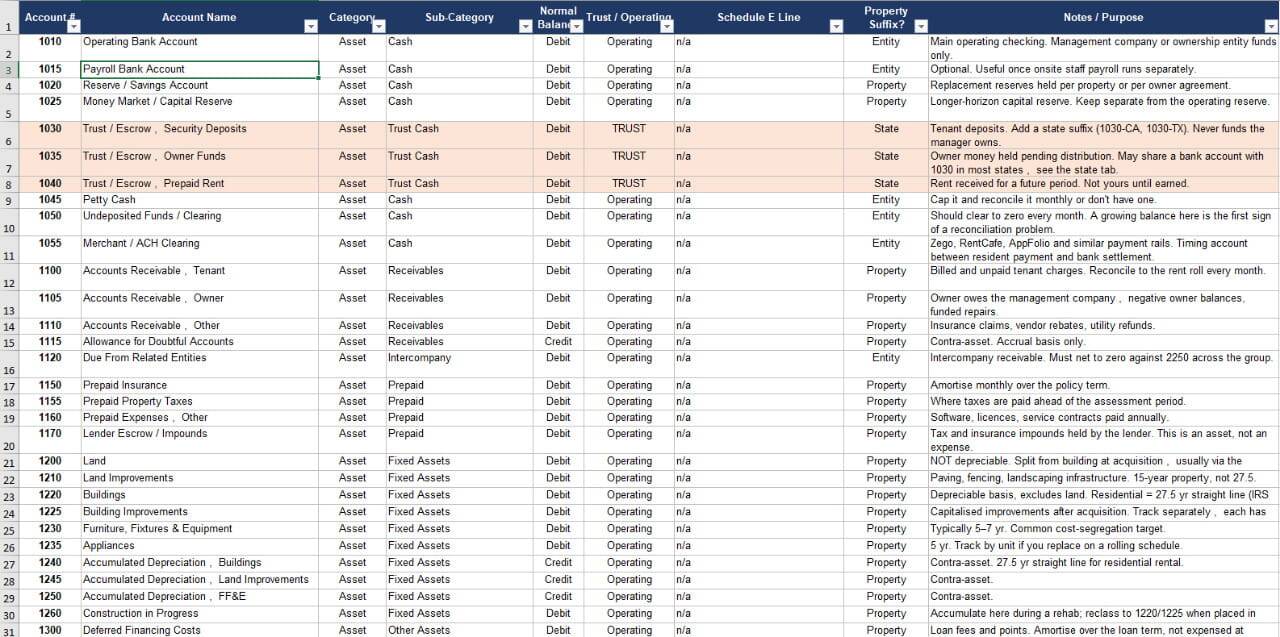
Sample Chart of Accounts Template
This is a simple starting template that incorporates property-level and multi-state suffixes. This demonstrates how the numbering actually plays out across a real portfolio, not just one property in isolation.
| Account # | Account Name | Category | Notes / Purpose |
| 1010 | Operating Bank Account | Asset | Main checking account |
| 1020 | Reserve/Savings Account | Asset | Held for future capital expenses |
| 1030-CA | Trust/Escrow Account (California) | Asset | Security deposits held, CA properties |
| 1030-TX | Trust/Escrow Account (Texas) | Asset | Security deposits held, TX properties |
| 1220 | Buildings | Asset | Depreciable basis (excludes land) |
| 1240 | Accumulated Depreciation | Asset | 27.5-year straight-line (IRS Pub 527) |
| 2000 | Accounts Payable | Liability | Vendor and contractor bills |
| 2100 | Tenant Security Deposits | Liability | Refundable liability (matches 1030 series) |
| 2200 | Mortgages and Loans | Liability | Debt principal balances |
| 3000 | Owner Contributions | Equity | Capital injected by owners |
| 3100 | Owner Distributions | Equity | Cash paid out to owners |
| 4010-01 | Rental Income (Property 1) | Revenue | Base rent, Building 1 |
| 4010-02 | Rental Income (Property 2) | Revenue | Base rent, Building 2 |
| 4020 | Pet Rent / Parking / Laundry | Revenue | Ancillary property revenue |
| 4030 | Late Fees / Application Fees | Revenue | Administrative fee income |
| 5010 | Advertising | Expense | Marketing and leasing costs |
| 5020 | Repairs & Maintenance | Expense | Sub-categorize by HVAC, plumbing, general |
| 5030 | Utilities | Expense | Water, power, gas overhead |
| 5050 | Property Taxes | Expense | Local tax assessments |
| 5060 | Management Fees | Expense | Management fee expense paid to the management entity. |
| 5080 | Depreciation | Expense | Tax deduction (Schedule E / Pub 527) |
A genuinely usable template needs to go beyond this snippet; most real portfolios contain 60 to over 100 accounts once every property and expense subcategory is accounted for. This captures the fundamental structure. It shows how property codes (4010-01, 4010-02) and state suffixes (1030-CA, 1030-TX) are actually applied in practice, rather than just described in the abstract.
Both AppFolio and Yardi ship with a starting property management chart of accounts built into the platform, which is usually a faster launch point than a blank spreadsheet. Rent Manager offers similar built-in structures. If you’d rather not build it yourself, we provide outsourced Yardi accounting and bookkeeping support and AppFolio bookkeeping services for firms on either platform.
Best Practices Worth Following
- Avoid creating a “miscellaneous” account. Rather, keep accounts detailed enough to capture relevant data.
- Try to align expense accounts as closely as possible to the IRS Schedule E. This saves time when preparing the tax return.
- Reconcile every month, not quarterly. Small reconciliation errors will compound the longer they are left.
- Limit who has access to edit the chart of accounts. Whoever has logged in that day should not make structural changes to the chart of accounts.
- Review the whole structure with a CPA at least once a year as the portfolio changes.
Common Mistakes to Avoid
- Mixing personal, business, and trust funds. This should be apparent, but mixing personal and business funds is a sure way to end up in a compliance mess.
- Inconsistent categorization. An example of such inconsistency is when one bookkeeper codes a repair as maintenance, while another bookkeeper codes the same repair as repairs.
- Ignoring depreciation. Skipping the depreciation account will create problems at tax time.
- Using a generic business chart of accounts instead of one designed for property-specific tracking and trust compliance can create problems.
- Not reconciling regularly. For a chart of accounts to be useful and effective, it must be updated and used properly every month.
Frequently Asked Questions
What’s the best chart of accounts structure for rental properties?
A block-numbered structure that includes the five major categories, including property-level sub-accounts, is flexible enough for most portfolios. Start simple and add granularity as the portfolio grows.
Do I need a separate account for trust funds?
You need trust funds kept separate from your operating money; that part is universal. Whether deposits and owner funds need their own separate accounts depends on your state; most allow one pooled trust account with per-beneficiary ledgers, while a handful of states require physically separate accounts.
Should I use a spreadsheet or property management software?
A spreadsheet can work for a small number of units. For trust accounting and reporting across multiple properties, software such as AppFolio’s expert bookkeeping services and outsourced Yardi accounting support handles the structure far more reliably than a manually maintained sheet.
How often should the chart of accounts be updated?
At a minimum, review the chart of accounts annually. It should be reviewed and updated each time there is a significant change to the portfolio. This may include a change of property, a change in the structure of the business, or a change in how the owners require the accounts to be managed.
The Bottom Line
A clean property management chart of accounts is the foundation everything else in your books sits on top of. Get the structure right early, and owner statements, tax prep, and trust accounting all get noticeably easier. Get it wrong, and every one of those tasks turns into a scramble to untangle where the numbers actually went.
If setting this up correctly, or fixing one that’s already gotten messy, feels like more than your team has time for, our outsourced real estate accounting services team builds clean, compliant charts of accounts for property managers running AppFolio, Yardi, and Rent Manager, and keeps trust accounting and month-end close on track all year.
We’re also an Authorized Rent Manager Solution Provider, one of a small number of firms holding that credential, so Rent Manager operators get the same depth of platform-specific support as AppFolio and Yardi clients. Book a meeting and we’ll walk through what a proper setup looks like for your portfolio.
Download Template
Sources and References
- IRS Publication 527 (Residential Rental Property): Official guidance on reporting rental real estate income, allowable expense deductions, depreciation methods, and the 27.5-year straight-line depreciation schedule.
- IRS Schedule E (Form 1040) Supplemental Income and Loss: Official tax form and instructions establishing standardized expense categories for residential rental real estate.
- Texas Real Estate Commission (TREC) Rules: Administrative code (specifically Rule §535.146) establishing mandatory trust fund segregation rules no later than the close of business on the second working day. .
- California Department of Real Estate Reference Book: Legal provisions regulating California real estate broker handling of client trust funds (Cal. Code Regs. Tit. 10, § 2832) and the mandatory 3-business-day deposit timeline.
About the Author
